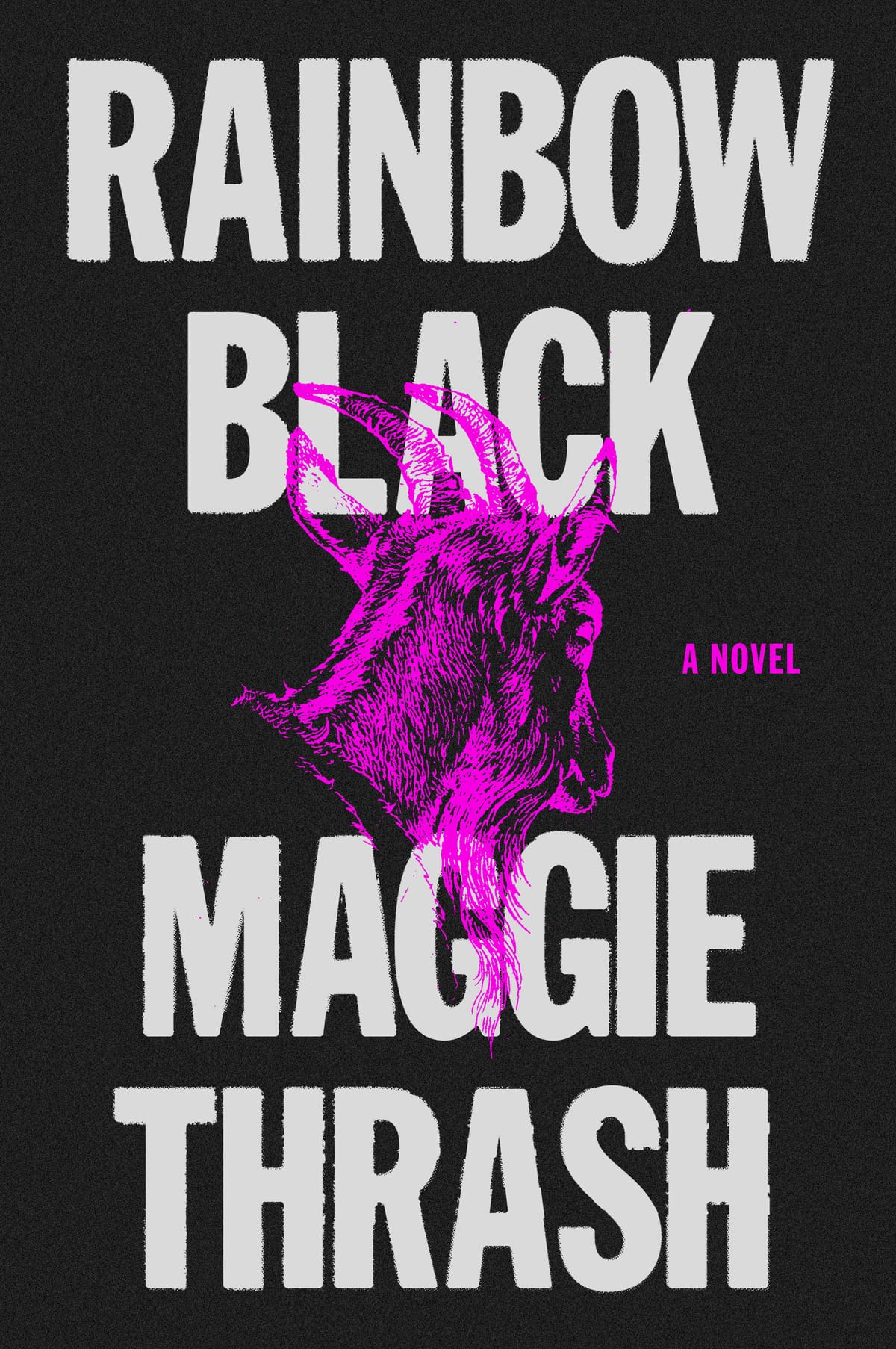
Chapter 2: Rainbow Black by Maggie Thrash

1988
OUR PARENTS OWNED A DAY CARE THEY RAN FROM OUR HOME IN New Hampshire—a converted old barn with a bright rainbow painted on the roof. Rainbow Kids Care, it was called. We had a little goat farm with five goats (Donny, Lonny, Sunny, Spunky, and Trailblazer) and a view overlooking untouched forest, the trees skeletons in winter, ruby red in fall. According to my dad, the trees were home to the fairy people who sat hidden in the branches and sprinkled fairy dust on our heads to keep us all safe and sound.
It was the 1980s, before those studies claiming that your kid would become a mentally ill delinquent if you didn’t pick the right preschool. Before the promises of “Baby Einstein Academy” or “Stepping-Stone to Success Day Care.” No one thought, when they handed over their two- through five-year-olds to my parents, that anything crucial was happening inside those two- through five-year-old brains. Keep the kids alive and reasonably happy until they could be picked up at the end of the day—that was the job. It was babysitting. Apple juice, graham crackers, finger painting, story time. I remember it all feeling pretty simple. Then again, every speck of my memory has been turned over, interrogated, and second-guessed to the point where I hardly know what I remember and what I don’t.
The day after she graduated high school, Éclair put us all in the rearview mirror and moved to Miami, about as far away from New Hampshire as a person could get while still technically being in America. Her dream was to be a backup dancer for Gloria Estefan, get “discovered,” and be propelled to stardom. She soon had a whole life of her own—a wardrobe comprised entirely of leopard print, a boyfriend with a car phone and his own exercise videotape company called Bangin’ Beach Bods—and her trips home were brief and infrequent.
Without her around, Days of Our Lives and One Life to Live lost their magic, and I stopped watching them. I’d gotten sort of nerdy and preferred books anyway. In the woods, there was an old shed kids called the “witch hut,” and I practically lived there, reading and listening to my Walkman and doing nothing.
But what were you doing in the woods?
I was asked this a hundred times, years later, in the sterile white office of a police station.
Nothing. I was doing nothing.
Adults seem to forget that between the grind of childhood (art time, nap time, snack time) and the grind of teenagedom (soccer practice, homework, party), there is a brief, sweet set of years where no one cares what you do, and you roam free. How could I explain the idle magic of these afternoons without sounding insane? That I collected rocks and gave them names, that I imagined clouds had personalities, that I believed animals would talk to you if they trusted you. Walking, walking, walking, practically losing my identity as I followed a red fox for miles into the forest.
I took after my mother, who was always more interested in animals than in people. The two of us would discuss our animal neighbors endlessly, like a pair of ladies gossiping at the hairdresser, except instead of so-and-so got drunk and wrecked his truck or so-and-so is sleeping with the mailman, it was the black bear found a new patch of berries or the skunk’s babies all had pure white tails. Occasionally my dad would interrupt us with some news from the real world:
“I’m bringing Dylan Fairbanks to stay for the week. His mom’s been arrested again, and she’s trying to make bail.”
Mom would seem momentarily confused, as if trying to remember which animal of the forest Dylan Fairbanks was and why we would ever bring him in the house.
“. . . Oh, of course, put him in Éclair’s room. How about I take them to the movies tonight? I need a little change of pace. Does Dylan like movies, Lacey?”
I shrugged. All I really knew about Dylan was that he loved NASCAR, or at least I assumed he did, because he wore the same threadbare NASCAR T-shirt every day. Only much later would it occur to me that, quite possibly, it was the only shirt Dylan owned. I was too sheltered to understand all the things I took for granted, like clothes and a stable home life. And I was dying to know what bad thing Dylan’s mom had done to wind up behind bars. Was she a bank robber? A Soviet spy? But I was too shy to ask Dylan, and my mom wouldn’t tell.
We got to the Stardust drive-in movie theater as the sun was setting, and Mom spread a quilt on the grassy knoll up front, in the family-friendly area. I didn’t see many kids as young as me and Dylan there. Alien was playing, and as soon as the movie started, it was clear that it wasn’t meant for children—no talking animals or goofy sidekicks or precocious kid characters. The dark, industrial spaceship was ominous and unsettling, and when the alien finally appeared, it was so terrifying I stopped breathing. Part of me loved it; I had never been so thrilled in my life. But another part of me was already blaming my mother: Why are you letting me watch this?
At some point in the middle of the movie my mom leaned over and asked Dylan and me if we’d like popcorn and hot dogs. I thought she was joking. Hot dogs? Mom always said the body was a temple and the meat industry was the axis of evil.
“Ketchup and mustard? Ketchup and mustard? What do you like on your hot dogs?” She looked from Dylan to me, weirdly agitated. I shrugged, baffled. Then she trotted off into the darkness without waiting for an answer.
The movie was scaring me to death, and I kept glancing at Dylan to see if he was as terrified as I was. But he had the same dim look on his face as always. And when it was over, all he said was “If I met an alien, I would do a karate chop and its head would fall off.”
Mom never came back with the popcorn and hot dogs. I looked around and felt a creepy disconnect from reality—was this still the movie? If I opened the car door, would I find her body torn apart and a slimy alien waiting to leap out at me?
The family-friendly area was emptying out. A caravan of minivans streamed through the front gate, leaving behind popcorn-littered turf and derelicts and people with nowhere else to be: a teenage gang kicking abandoned cups across the gravel lot, cherry Slurpee spills arcing like blood splatters; a trailer park couple drinking from a jar while a baby howled in their junky back seat; a too-thin man leaning against the chain-link fence, flashing a switchblade open and shut: click, click, click. I felt lost, though I hadn’t moved an inch from the quilt where my mother had left us—it was everything around me that had changed. Even the group of hippies in their peace-sign T-shirts seemed suddenly homeless and addled. They weren’t holding hands or strumming guitars like in Alice’s Restaurant; they were arguing viciously, pointing fingers at each other: “Your fault!” “No, your fault!” You heard a lot in those days about how the region was falling apart; this was the first time I’d ever seen it with my own eyes.
“Where’s my mom?” I asked. Without waiting for Dylan to answer, I said, “Maybe we should wait in the car.”
But the car was locked. I didn’t know what to do. Should we stay put, or sneak into a dark corner and hide? I decided we should look for her. Sitting on the knoll was like asking to be kidnapped. It was the age of “stranger danger”; every kid at school knew someone who knew someone who’d gotten AIDS from a candy bar or been abducted and sold to the Amish.
“Look at those kiddies,” I heard someone say. “They’re on a hot date. Hey, kids! Kiddies! C’mere! Where your daddies at?”
Just like during the movie, I checked Dylan’s face to see if he was scared, but he seemed totally unfazed. Maybe in his world it was normal for moms to randomly vanish. At the Snack Shack, a boy with yellow teeth was sweeping up. I wanted to ask if he’d seen my mom, but I was smart enough not to advertise that Dylan and I were alone.
“I think we should call 911,” I said.
Dylan shook his head. “No, no. Call my neighbor.”
“What? What are you talking about?”
“When I can’t find my mom I’m supposed to call my neighbor.”
I couldn’t believe it. Call 911 was drilled into the head of every kid I knew. My friend Sandy had once called 911 when she couldn’t find her cat for ten minutes. I’d never met anyone who’d been told to call their neighbor.
“Well, who’s your neighbor?” I asked.
“Hank.”
“Who’s Hank?”
“My neighbor.”
I decided to call my dad and ask him if I should call 911. I don’t remember how I found a dime for the pay phone. Maybe Dylan had one, or maybe I begged one from the yellow-toothed guy in the Snack Shack. In any case, I dropped the coin in the slot, pushed the grimy buttons, and waited for my dad to pick up.
“4431.” To the bewilderment of most people, my dad always answered the phone with the last four digits of our number. He was a British expat, and that’s how he’d grown up doing it in England.
“Daddy? I can’t find Mom. She went to get us hot dogs and she never came back.” There was a pause. I wondered if he hadn’t heard me. “Daddy? Hello?”
“Lacey, listen to me. Don’t move. Stay with Dylan and don’t move an inch. I’ll be there in ten minutes.” He spoke urgently, with a no-nonsense tone I’d hardly ever heard in his voice before. It scared me.
“Should I call 911?”
“No.”
I looked at Dylan. What did he and my dad know that I didn’t? What was the point of all those videos we’d watched in school about Mikey and Janie and Susie and their various emergencies if we weren’t supposed to call 911? I hung up the phone.
“Hey, kiddies. You on a hot date? You gonna go all the way?”
It was one of the teenagers wearing sunglasses. I looked away, which was what we had learned in the Just Say No after-school program. Never make eye contact with someone on dope, because they might “wig out” and attack you.
I hid myself behind the phone booth. Nearby, Dylan had found a half-finished hot dog on a table and was eating it.
“Well, I’m glad you got your hot dog,” I said.
“Me, too,” Dylan agreed, his mouth full.
I was being sarcastic, I growled at him in my mind.
A monotone voice sounded over the drive-in speakers: “The Stardust will be closing soon, please make your way to the exit.”
I felt a lump forming in my throat. Don’t cry, don’t cry, don’t cry.
Finally I heard a crunch of gravel as my dad tore into the lot. He was driving the old VW bus that we hardly ever used because it always broke down. I ran up to him, Dylan padding after me.
Dad leapt out of the van. “Get in now,” he barked at us, and we obeyed. Everything felt confused, and I didn’t know what scared me most: aliens, hoodlums, missing moms, dope fiends, the man with the switchblade—they all mixed together in the darkness.
The windows of the bus were dirty, and we couldn’t see what was happening outside in the gravel lot. I heard my dad yelling, “That’s my wife! Move aside!”
I was shaking. My mother was lying there dead, I was sure. Strangely, all I could think about was how much I didn’t want Dylan to see me cry.
A man shouted, “You dirty hippies, get outta here, you filthy pieces of shit, get a job, wear some shoes, this is America, you commie Jew trash, get the fuck outta my place of business!”
Then a gunshot. Dylan and I both heard it and shrieked.
The passenger door groaned open. Dad had Mom in his arms. She was alive—I could tell by the delicate way he placed her in the van, like a knight who’d rescued a princess from a dragon. Relief flooded me. Before I could open my mouth to ask what was happening, he said in a strangely calm voice, “Don’t be scared. Your mom fainted. It’s just the bloody arse of a manager, shooting his gun in the air. Just trying to scare us. Everything’s hunky-dory. Just a little silly drama.”
In the weeks to come, he’d refuse to tell me a version of the story that I found satisfactory. So I had to make one up myself. Maybe the hippies had attacked my mother for buying a meat product, or maybe the man with the switchblade had tried to murder her because she resembled an ex-wife who had stolen his money and faked her own death.
My dad’s explanation, repeated many times to me, was completely insufficient: “Your mother fainted. And the manager wasn’t nice about it.”
“But why was everyone yelling?”
“Because when people are confused, they yell.”
“Why were they confused?”
“Because it was dark and no one could see what was happening.”
“Which was what?”
“Which was exactly what I said. Your mother fainted, and the manager is a mean man who doesn’t like freethinking people.”
“But doesn’t he know this is New Hampshire?” I asked. From a young age I’d taken our state motto, “Live Free or Die,” very seriously.
My dad gave an exhausted smile. “I’m sure he does. And that, my sweet, is called irony.”
The next morning my mother stayed in bed all day, listening to the Moody Blues on her record player and reading The Feminine Mystique. Dad said she needed to rest and I shouldn’t bother her. I was tiptoeing around the house, hoping I’d overhear something that might explain what had really happened.
“Lacey? Is that you? Will you pick me some violets from the yard? I need a little extra color today.”
I picked the violets, put them in a jar, and brought them back to her. She patted the bed next to her. Finally, I thought, ready to hear the full story.
But I was quickly disappointed, as she proceeded to give a scattered speech about how brave I was to call my dad and look after Dylan until he got there, and how the path to womanhood was a song with a thousand beautiful verses.
“But what happened?” I whined.
Her tranquil smile went flat. “Lacey, life is an art, not a science. Facts don’t exist. Just live in the moment.”
While these pseudo-philosophical question-avoiding tactics worked on a ten-year-old, they would later do her incredible damage. You can’t tell law enforcement officers, a judge, and a jury that facts don’t exist.
I couldn’t wait to tell Éclair what had happened. The story contained so many motifs from her beloved Days of Our Lives: a damsel, a hero, gunshots, fainting, an array of mysterious strangers. Once a month I was allowed a very expensive long-distance call with her in Miami.
But when I told her the story, her reaction was not at all what I’d hoped.
“Éclair, did you hear what I said? There was a gunshot. And Dad was carrying Mom and she was unconscious. And the manager was screaming every bad word I’ve ever heard.”
There was a long pause. Finally Éclair said, “Lacey, I want you to promise me never to go to the Stardust again.”
“Well, Daddy says the manager is a bigot and we won’t be patronizing his establishment anyway.”
“I’m sure that’s what he says. . . .”
I’d been waiting for days to talk to Éclair, and the tepidness of her response made my heart deflate like a day-old balloon. She was barely interested in any of my wild theories and kept repeating, “Just promise not to go there, okay?”
When I tried to discuss the incident with Dylan, still loafing at our house while his mom sat in jail, he didn’t seem to grasp that anything unusual had happened. He told me, delightedly, “One time, at the mall, the police chased me and my mom, and I got to hide in a suitcase in the luggage department for five whole hours!”
With no other options, I begged my dad constantly, “Please, please, please tell me what happened.”
One day it seemed like he was about to crack. We were in the study, an austere room full of books and framed prints of moths and butterflies from the nineteenth century. “Lacey, come here,” he said, gesturing to his knee. I hadn’t sat in anyone’s lap in ages, fancying myself basically an adult, and I hesitated.
“Come here,” he repeated, and I obeyed. I was stiff and awkward at first; I’d grown tall for my age and didn’t fit snugly in his arm the way I used to. But once I stopped resisting, I felt the heavy cloak of father and daughter settle around our shoulders, musty with age but warm as ever. It was a love story largely unwritten; I’d consumed enough Greek mythology to notice that when daughters appeared in the stories at all, it was usually to be married off, locked up, or killed by their dads.
My father struck a match and lit his old briarwood pipe. He smoked English Cavendish tobacco. I loved the smell of it and breathed in as much as I could.
“I know you think you’re all grown up,” he said, “but there are things you don’t understand about the world.”
“What things?”
“You don’t need to know. All you need to know is that I’m here, and I’ll protect you. I promise I will never let anything bad happen to you or your mother or Éclair. Do you believe me?”
I was unsure. Dad was a male preschool teacher, hardly anyone’s idea of Superman. And yet, the way he’d shown up at the Stardust and saved us all had been nothing short of heroic. I weighed these things, making my decision, and if that seems precocious, I assure you it ended up being the same decision any ten-year-old would make: to choose to believe her parents would deliver on their promises.
“Yes,” I said finally.
My dad rubbed the top of my head. “Good. Then stop this silly behavior. Go back to living your life.”
And I knew then that the conversation was over, that I’d gotten all the information I was going to get. Life resumed, and it became clear that nothing like that night at the Stardust was going to happen again. My curiosity faded. But at odd times, trying to fall asleep during a full moon or walking home from the bus stop with a book in my hand, my mind would wander back, and long-sunk questions would bob to the surface: Where was my mom for the entire second half of the movie? Why had the manager shot the gun in the first place? It seemed like a fairly extreme way to inform people that the drive-in was closed. Was there something I’d forgotten, a piece of the puzzle lost at sea and disintegrating into the black water? I could almost feel it, floating just out of reach. Something. Something. I remember. I remember.