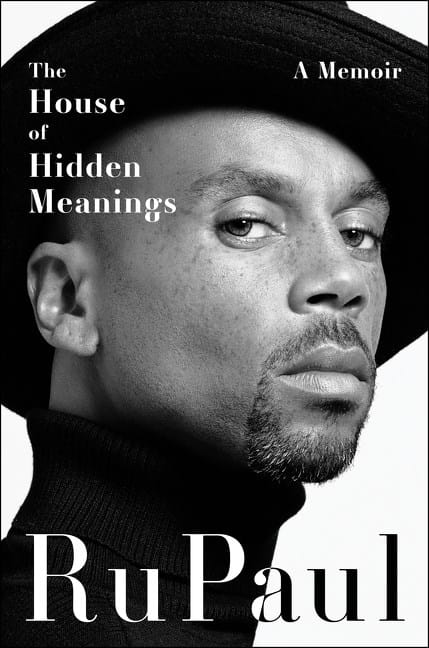
Chapter 1: The House of Hidden Meanings by RuPaul
First, a memory. I can see it in my mind like a snapshot, clear as a photograph. I was five years old, and I was in the backyard of the house where I grew up in San Diego with my older sister Renetta.

“I go out onstage. I leave home, over and over again, and then I sit on that porch, waiting for my
Goodbye
father, knowing that he will never come, and then I let him go, time after time. I say goodbye.”
First, a memory. I can see it in my mind like a snapshot, clear as a photograph. I was five years old, and I was in the backyard of the house where I grew up in San Diego with my older sister Renetta. She spread a blanket out on the grass, took out a brown paper bag, and from the paper bag poured some homemade peanut butter cookies, which were my favorite. I was wearing a blue-and-white-striped shirt and green cotton pants.
We sat on the blanket and ate the cookies. I ate mine slow, savoring every bite, feeling under my thumb the latticework of the forkprint pressed into the top of the cookie. The sun was shining, but the sun always shone in Southern California. That just meant the gray days were the ones you remembered the most.
“This is a picnic,” Renetta said.
“A picnic,” I repeated. She nodded.
In this moment, I could feel that she was telling me something important, even if I wasn’t yet old enough to grasp the meaning in its fullest form. But eventually, I would come to see: By naming it, she was making the moment something more than it was. We weren’t just eating cookies on a blanket. The ceremony, the theater of it—that was what anointed this as something extraordinary, the creation of a kind of magic. Reality was suspended; the rules here were different. Eating cookies on a blanket was a regular thing to do, but a picnic? Now that was something special.
Magic, I saw for the first time, was a choice. And it must be created.
Renetta and I looked at each other. “I love it,” I said. “I can’t wait to do it again.”
I think about this moment often because it was an awakening of something within me—the discovery that you can create your own magic. Developing the ability to create it out of necessity, even out of survival, teaches you how to be a magician for the pure love of it. We all have that magic within us. But it’s the faculty to harness it—to turn something seemingly meaningless into something special, to be loose and spontaneous with it—that makes life most worth living.
I needed that, as a little boy growing up in San Diego—because I felt magical, but my immediate surroundings did not. The house where I grew up was in a development called Michelle Manor. It was less than ten miles from the beach, but folks from around there never went near the ocean. The neighborhood was all canyon back then, filled with little houses like the one my mother and father bought on Hal Street for $14,500 in 1958. From the front yard, on a clear day, you could see Mexico. On a cloudy day, you could still see the drive-in movie theater where they played blaxploitation films: Even if you couldn’t hear the audio, you could make out just enough to keep up.
It was easiest to find the magic on the television set, which was the epicenter of possibility in our house. When I was very young, my parents kept it in their bedroom. All of us would crowd into my parents’ bed and watch it, the gray light dancing across the chenille bedspread. I would sit on my father’s shoulders and lick the top of his head, which was salty; it must have been sweat. Maybe he thought it was cute. I remember it so vividly because it was one of the only times I felt close to him, physically or otherwise.
On television, people were usually doing things in places that seemed much bigger than the world in San Diego, which always felt like a tiny tributary separated from the flow of the wide, rushing river of life. The television set represented a window into something greater, a portal to new worlds.
In commercials, people were glamorous and adult, like Edie Adams vamping in a spot for Muriel Cigars in the style of Mae West: “Why don’t you pick one up and smoke it sometime?” she intoned, standing in a surreal musical set wearing a gown and a fur coat. Her hair was a helmet, and she had liquid eyeliner drawn to her temples and dark, painted lips. I wanted to be just like her: gorgeous, in control, performing to a rapt audience. And, perhaps, feminine—in control of a man’s attention. Though at that time I didn’t have the vocabulary to describe any of that.
Anne Francis had a detective show for one season called Honey West that rocked my world; she kept a pet ocelot, and she didn’t play by society’s rules. On Mission: Impossible, the heroes—members of a top-secret intelligence agency—would target people based on their particular vulnerabilities, building entire set pieces to entrap them, using elaborate disguises and deceptions. I loved what this indicated to me about the world and the people who moved through it: You could cater to them, if only you understood who they were, to get what you need.
There were terrors on the television, too, images that spoke to my anxieties. On an episode of East Side West Side, there was a couple whose baby was bitten by a rat while lying peacefully in its bassinet. Because of this, I developed a thing about rats. There was a woman in the neighborhood named Irene who was friends with my mother, and there was a distinctive smell in her house—mothballs, rat shit—that turned my stomach. Plus, I knew that rats were smart and sneaky, and that made me see them as dangerous—maybe because I thought of myself as both of those things, too.
On that screen, there was also a sense of righteousness—of progress that was reflected in the shows we watched. In the products for which commercials were broadcast, technological advancements were improving things for all of us, all the time. I understood from the way my parents talked about it that there were more Black people on television than there had been before. My older sisters told me that the people in charge would make it so that one day, everyone on the planet would have thirteen pairs of shoes—unlike me, who had only one pair, or my sisters, who had three pairs each at most. The world was getting better all the time! In the meantime, in the programs we watched, there was a kind of moral clarity that the real world didn’t have. Right and wrong. Good and bad.
I loved television. Television, to me, represented the platonic ideal of reality. First of all, there was a moral code. The good guys vanquishing the bad guys. Good triumphing over evil.
But even more crucially, the fact that it was all a performance was acknowledged. We knew these were actors playing roles because their names appeared in the credits. In the real world, everyone played parts, too, but nobody talked about it.
At the picnic, as was the case on television, Renetta and I had both played our roles. She was the facilitator of magic, and I was the beneficiary of it. She had created a show and then invited me onto the set.
I was the one who was always putting on a show for my mother. I would take a broom, wrap a towel or a scarf around my head, and make an outfit, impersonating Tina Turner, or Carol Burnett, or LaWanda Page, who played Aunt Esther on Sanford and Son. I would impersonate people in the neighborhood, like our neighbors across the street, the Wafer kids—Thelma, Shirley, Raleigh, and Bruce—who talked real country, in a thick drawl. If she sat down to watch me, I knew I would be able to make my mother laugh, but it was still satisfying whenever it happened.
My mother was a stoic woman. In the neighborhood, she was known as Mean Miss Charles. She had been named Ernestine after her mother. When she was sixteen, during a fight with her mother—my grandmother—the elder Ernestine said, “I wish I hadn’t given you my name.”
“Fine,” my mother said. “It’s not my name anymore.” From then on, everyone called her Toni.
This was classic her: stubborn, proud. She wasn’t an easy woman. But if she liked you, she liked you. And she liked me because I was easy. Yet her coldness meant that I never stopped trying to earn her affection. She had never gotten along with her mother, but she revered her father; she was his favorite, and she knew it.
She was descended from freed slaves, and both her parents were mixed-race; back then, she would have been called “mulatto.” Her hair was sandy brown and mostly straight, although it had a curl to it; she put it in rollers so it would curl from the front to the back, the hairstyle Suzanne Pleshette wore on The Bob Newhart Show, which we called a Beethoven. Growing up, kids at school would tease, “Your mama’s white,” but she didn’t look white to me.
Maybe because she was contrarian, she loved dark-skinned people, like my father, Irving, who she met in Beaumont, Texas, while she was working as a secretary. They met on a blind date. He was serving in the army—there was a base there—but they were both originally from Louisiana; my mother from a town called St. Martinville, my father from Mansfield. They must have had an incredible connection at first, something physically electric, the tension that comes from two people who are so unlike each other. He didn’t believe they could get pregnant the first time they had sex, but she did—with twins. Upon his return from Germany, they married.
My parents were bound to end up at odds with each other. She was so world-weary, and he was such a charmer. In the beginning, I think, she must have represented a challenge to him: When she did smile, or laugh, there was such a payoff. For her, he was a jolt of fun. He took her out of that world-weariness that she’d had since she was a little girl. But when all that burned out, there was nothing left to hold them together. Often when people get together because of sex or some animal magnetism and that wears off, they end up thinking: I don’t like this motherfucker.
While my father was serving in Germany, my mother gave birth to my older sisters, Renae and Renetta. She was overwhelmed raising two children alone, so for a time, she sent Renae, who was lighter-skinned, to live with my grandmother. I understood it to be a kind of peace offering to her mother for having children with a darker-skinned man. But it created a fissure in my mother’s relationship with Renae that never healed—that she sent her away and separated her from her twin sister for two years. Their relationship was always contentious after that. Renetta, meanwhile, was my mother’s favorite, which was funny, because she was optimistic to a fault, and my mother was such a pessimist. A year after I was born, my mother gave birth to my sister Rozy, who was somewhere in between temperamentally: She ran hot and cold. But none of my sisters performed for my mother the way I did: imitations, bits, sketches, little scraps of makeshift theater.
I would sit in her bedroom, gazing into her big art deco vanity mirror—at least, I think it was art deco; it could have just been old—with rounded curves and little engraved flowers, and do commercials for Coty cosmetics. I put her powder on and whipped a towel around my head as if it were a lustrous head of hair. “Yes! It’s Coty!” She would have been in a bad mood because she was always in a bad mood, but when I did that, she would break character and laugh. That was my single goal: to pierce the dark cloud of her unhappiness for just long enough to help her forget that anything was wrong.
I will never know exactly what happened to my mother when she was young. She wouldn’t tell us much; her narrative was very edited. But I had the sense, intuitively, that she’d been sexually compromised early on. She also intimated that she’d had a horseback riding accident when she was fourteen that had given her issues with her left eye, but after she died, I discovered that she’d had a glass eye my entire life. The fact that I’d never known that astonished me.
She was hotheaded, a Leo. Once she got mad, all bets were off. If we were goofing about in the grocery store, she would let us have it with no concern for how embarrassing it might be. “Shut the fuck up!” she’d yell from across an aisle of canned foods.
All the kids in the neighborhood knew you didn’t fuck with Mean Miss Charles. She didn’t have time for bullshit. God help the Jehovah’s Witnesses who approached the house to find her sitting at the table, drinking her coffee and smoking a cigarette, in full view of their approach. They’d knock on the door, wave to her through the window. She wouldn’t even get up. She would just look at them and say, “Get off my fuckin’ property.”
I knew that she felt justified in being so flinty because of what had been done to her throughout her life, but it was also where she came from; her background was Acadian French. As an adult, when I began spending time in France, I would see shades of my mother in the people I met, who could be haughty and superior, or even downright rude. But back then, I had no context. When I heard her on the phone with her sisters, speaking Creole French, it was like an alien had landed in the kitchen.
She felt like the game was rigged against her, so she was tough, and then people were unkind to her because she was tough, which reinforced her belief that the game was rigged against her. My father’s family disliked her: They thought she was purposefully ornery, that she thought she was better than them, and she probably gave them plenty of reason to think so.
The rift between my mother and my father’s sisters was solidified one New Year’s, when my parents went up to Los Angeles to his sister’s house. They were staying with her—my aunt—and my mother had sewn a beautiful look—a sleeveless, tailored black crepe wool cocktail dress, with pearls and jewels embroidered around the empire waist—to wear that night for the holiday. She laid it on the bed in the morning and left the room. Later in the day, when she went to change into the dress, she found it in ribbons. Someone had slashed it with a razor.
She said nothing. She just wore a different dress instead. But she held on to that act for years—and to those shredded pieces of shimmering black wool. In every possible way she held on to that dress, and she allowed it to fuel her. It represented all the world-weariness she had experienced. It was proof positive that she was not wrong in how hideous and cruel this world could be. And this—her belief in the cruelty of the world—was like a drug to her, something that she returned to again and again, reminding herself that she had been right all along.
My mother had been raised Catholic. She still read the Bible, sometimes with her friend Sister Harris, and I knew she believed in God, but I understood that her relationship with faith was as a moral touchstone, not as dogma. She didn’t fuck with organized religion once she was an adult. She would never have given her power away to a preacher. She believed they were all crooks and hypocrites. I think she knew I was gay from the very beginning, but I never felt any judgment from her about it. Her life philosophy was laissez-faire. “If they ain’t paying your bills, pay them bitches no mind,” she would say.
To her, mantras like that were a form of religion: to speak out loud, to remind herself of her own truth. They were totems to help her remember where she came from, where she was going, and not to fall prey to the manipulations of others. I inherited my fondness for turns of phrase from her, but perhaps with more skepticism for the Bible. I can remember being young and hearing stories from the Bible and thinking they didn’t sound quite right. In my mind, religion simplifies complicated concepts so people can understand them more easily. “The devil” is the ego; “God” is a frequency that cannot be explained; “Jesus” is a term for the potential that we all have, the potential for us to transcend the physical illusion and to remember who we are, which is an extension of the God-force. The truth is, I don’t think either of us took any Biblical doctrine too literally.
From my mother I learned independence and self-sufficiency, the invaluable skill of being able to be on your own, to finish a job without requiring anyone’s help. My mother could get shit done: When the front yard needed tending, she would go out there and pull weeds and prune bushes, wearing a durable, machine-washable polyester caftan in an abstract black-and-white print that gave the impression of flowers. But even with her very hard shell, I understood that depression sometimes got the best of her.
“Ru, you’re too goddamn sensitive, and you reminisce too much,” she told me once when I was only five years old.
Years later, I realized what she was doing—she was telling on herself. She was trying to protect me from the mistakes she had made. My father’s charms had allowed her to access within herself a sentimentality that she, tough as she was, couldn’t feel otherwise. But once he disappointed her, she came to see that softness as her Achilles’ heel. I knew she indulged it privately, living in nostalgia, the romantic fantasy of what was or could be again, but it seemed she only knew how to harden herself against the world. We had both been glamoured by my father, and she didn’t want me to fall for it—getting hooked on his lure only to end up hurt, the way he had hurt her. Instead, she tried to prune the tendency out of me like it was a weed in the front yard.
I can see her now in my memory, the way she looked taking me to my first day of kindergarten at Horton Elementary. She was wearing a dress that, later, I would come to discover was a knockoff of a Dior silhouette: It was cinched at the waist then gathered out, with buttons down the front, a popped collar, and a three-quarter sleeve. It was deep brown, light brown, and beige, with geometric shapes—overlapping circles that created a pattern. She was so glamorous to me. I was holding her hand as I looked up at her.
I must have known on some level that this was the end of my being with her all the time. I was traveling through a portal to a different world now, and my life would never be the same again. One of the hardest things for me to accept about life, still, is saying goodbye.
Nobody ended up in San Diego by accident. Back then, it was very white, very conservative, and very segregated. It was a sleepy place to live, provincial—a military town. People from all over the country who conceived of being in the armed forces as a career plan wound up there.
The military culture converged with the old mission culture from when the Spaniards took over Mexico. But the missions built by priests crumbled, and in their place men built aerospace factories to send us rocketing toward the heavens. I didn’t find that particularly poetic at the time; if anything, it bored me senseless. But in hindsight, it was useful. Being in San Diego gave me such a long period of gestation to become who I was meant to be.
My father had decided to come to San Diego as part of the Great Migration, as Black people moved first North and then across the country in waves. It had begun with Baltimore, then farther out into the Midwest to cities like Chicago and Detroit. The last wave of the migration was Black people from Texas and Louisiana moving West and settling out in California. My father had fourteen brothers and sisters, and of those fourteen, I’d guess ten of them moved to San Francisco, Los Angeles, or San Diego. He worked at McDonnell Douglas, which meant he, too, was part of the war machine, making airplanes.
All the Black people in our neighborhood were transplants from the South, and so they had inherited a kind of slave mentality, which was based on fear. When you hear stereotypes about Black people who can’t swim or are afraid of dogs, it’s because for so many generations, they were afraid of swimming across bodies of water to flee, or afraid of dogs because they were scared of being chased. Those fears are epigenetic—they burrow deep into the subconscious, creating an internal paradigm of rules that you forget can be broken. Systemic oppression creates walls that can feel impossible to scale, but so, too, does the inherited belief that you are a victim. People hold on to that victim mentality so fiercely; it becomes a defining feature of their identity. Nobody’s going to take that away from them. It runs too deeply to take out and examine under the light.
My father had it, too. As charismatic as he could be, he was ultimately shallow, afraid, unable to transcend the strictures of what he saw as his reality. He was too ruled by his fears of being truly himself to allow me to be myself. Maybe I illuminated the pieces of him that were feminine, that pushed the boundaries. I could see myself in him and his side of the family, in the way they laughed and danced and had a good time. But it wasn’t reciprocal: They could not give themselves permission to see their reflections in me.
My inheritance from my father was a stage presence. It’s true that he performed warmly for the girls. Even if it was a routine—just a kind of stand-up set—he’d perform for them but never for me. It was as if he didn’t know what to do with me. He’d take me down to Tijuana, which was only twelve miles from where we lived but felt like another world, to get my hair cut for fifty cents, then out for an orange soda as a reward. Or we’d go to Nati’s for chicken tacos or beans and rice and chorizo so good it makes my mouth water just thinking about it. But I always felt the distance from my father. Physically, I was a replica of him—a mirror he couldn’t stand to look in for too long.
When I was a kid, I used to think about the smartest people in the world. What were they doing? What were they thinking about? I felt certain that they weren’t people with platforms—the politicians in Washington or the movie stars in Hollywood. The smartest people in the world, I believed, weren’t people you would ever hear from, because the smartest people in the world were smart enough to keep their mouths shut. They understood that you would be burned at the stake if you showed how much you knew.
In nearly every Western, the good guy—the sheriff—goes off running after the bad guy while the deputy has the innocent person locked up. Somehow, the townspeople get the wrongly accused person out of jail, string them up, and hang them before the sheriff can come back to town. The sheriff comes back with the real killer and says: “What have you done?”
I understood what this motif meant: Mob mentality is dumb and dangerous. And the mob is never out for justice—they’re only ever out for blood. The number one evil that we face is unconsciousness. And I knew early on that it could be perilous to show that you could pierce the veil.
My father’s family, like the people in my neighborhood in San Diego, like my father himself, were all still slaves. They were afraid of everything. They sought validation to assuage their fears, and it made them feel good for a minute, but they were not free. I knew that these were not my people; I shared a sense of humor with them, but only that. In sensibility, I saw more of myself in my mother’s French heritage.
I can remember being five years old and standing in a group with some other kids when one of them called me a sissy for the first time. What did that even mean? I wasn’t sure, but I knew it was an accusation from which I had to defend myself. As with the picnic, and just like on television, I understood in a wordless way that there was a play going on, and in that play, roles were assigned. Now, as long as I was in San Diego, I had to navigate the role that had been assigned to me, which at the time was “sissy.” Everyone else had roles, too, and it was vital that I figure out what they were, because I had just been born into a game with rules that I had to learn in order to win.
The problem was that being a sissy was not a significant part of what anyone deemed the bigger picture. I had been assigned a role that was not important within the value system of the world at large, especially since I didn’t have the meaning to assign to the word. I knew that I had my own magic, but most people couldn’t see it. I’d have to prove my value another way.
And yet, even if I was seen as a sissy, I felt that I had always been provided for—protected, even. When I was in the second grade, kids would either eat a packed lunch in the cafeteria or walk home to have lunch, then come back in time for recess. Most days, I went home to eat oatmeal with raisins. One day I reached for the doorknob and found that the door was locked. I knocked, and no one arrived. I thought it was odd; my mother would normally be at home. Immediately, I thought that something must have happened, and it probably had to do with my mother and father—something with their relationship that had caused my mother to not be home. There was no other reason she would be out; she didn’t even drive.
I sat on the porch waiting for her to come. I waited for a long time—long enough for whatever recess I would have enjoyed by coming back to end. By the time I returned to school, I was hungry, and as we lined up to go back into the classroom, I began to cry. It wasn’t for attention—even at that age, I was good at keeping it together. But I couldn’t hold back the tears.
A girl behind me saw me. “Mrs. Lang!” she called. “RuPaul is crying!” All the other kids stopped chattering and roughhousing as their attention turned toward me.
Mrs. Lang was a long-limbed white woman who wore a colorless dress and cat-eye glasses and had hair like Mamie Eisenhower. She came over, pulled a pad and pencil out of a pocket, and scribbled a note down. “Take this to the cafeteria,” she said.
I walked to the empty cafeteria and handed the note to the lunch lady, who gave me a tray with a hot dog and some potato chips on it. I went to sit down at a table, and saw that the principal was sitting there already, wearing a short-sleeved white shirt tucked into slacks and a long skinny tie. I put my tray down next to him and we ate lunch side by side, and I knew that I was taken care of. My needs were met.
Why has this memory stuck with me all these years? The close call of a crisis averted; the visceral fear of not knowing where my mother was; the physical discomfort of my hunger and the embarrassment of my tears—all of that, sure. But above all else, I remember it because it was the first time the world had reorganized itself to accommodate the way I felt, which was different, apart from others. I was the only kid in the cafeteria eating lunch with the principal.
In this, I was special. But I was also alone.
Another memory: My family was together at Belmont Park, an amusement park near Pacific Beach. That was where we would go for an outing on a summer Sunday; television and movies let us know that the beach was where the action happened. This was the choice, most coveted space. This was why the town existed in the first place: so everyone could be close to this beach.
I was five or six years old, and the boardwalk was teeming with white, middle-class navy families, lured here to San Diego by the promise of war propaganda. There was cotton candy residue around my mouth, the aroma of funnel cake in the air, and beneath it, with a sour tang, the lingering stench of throw-up. The sun in San Diego had a silvery hue, hot in its directness but cool in the shade. Everyone was looking up at the rides, which towered overhead—especially the Giant Dipper, an enormous, historic wooden roller coaster. I was looking from my father to my mother, and there was a feeling between us, my family. If I could put words to the feeling, they were: We can’t go on much longer like this.
And then we were heading back on Highway 94, back to the house on Hal Street in my father’s 1954 Plymouth. He was driving, with my mother in the passenger seat holding baby Rozy. I was in the back seat, in the middle between Renae and Renetta.
There was dead silence in the car. And in that moment, I knew this wasn’t good. I knew that these people did not like each other. In fact, they fucking hated each other. There was no joy—only hostility. Looking back, I think maybe we all felt, somewhere deep within us, that it was the last time we would ever do anything like that—this performance of family.
My father was self-centered and a cheater, but my mother would be the one to escalate things, picking up a lamp and throwing it across the room. We would run into the back room of the house and hunker down in the corner like refugees. Renetta, who was always a bleeding heart, would huddle us together; it was very cinematic, and she knew it. I never saw my mother bruised; maybe just one on her arm, from him holding her off. He must have hit her, though, because after he left, she would tell all of us, my sisters and me: “If a man hits you once, leave. It’s never going to get any better.”
Someone simply sitting on the retaining wall outside the house on Hal Street would be enough to incite my mom to anger: “Get the fuck up out my yard!” she’d yell from the window. So when my father got a convertible, a white Oldsmobile Delta 88, and started cheating on her with a woman named Betty who looked like a young Nichelle Nichols and had a cute little gap in her teeth, it was game over. One night when he came home late, she took a can of red paint and spray-painted the word BETTY on the side of his car. For years after, there was a little smudge of red paint on the garage door.
That garage door comes back not long later, in my memory, after the incident with the paint. But here I remember it open. My mother was angry with my father, as angry as she’d ever been. Renetta, Renae, Rozy, and I were standing on the other side of the street, watching a scene play out inside the garage.
She had poured gasoline all over his car. She was standing on the passenger side at the tail, holding a book of matches. “Motherfucker, I will light this bitch on fire,” she said. “I will light it on fire.” He was standing on the other side of his convertible, begging her not to. “Toni, please. Please, Toni.”
Everyone in the neighborhood was gathered around us, watching this scene. She had a captive audience, and she was willing to set the whole house on fire in her rage.
When I play this scene back in my memory, I see it as if I am a camera and I’m looking at me. Then I cut to my sisters’ shocked faces. There’s a dolly shot, then a crane shot. It’s spectacularly cinematic. Years later, I would understand that I had fully dissociated. I was too young to absorb what was really happening; it would have been shattering to me. So I simply left my body.
Eventually, Sister Harris came from up the street and convinced my mother to put the matches down. The fire trucks left, and nothing more happened. I’m not sure if my dad went back in the house or went to Betty’s. But we were all used to my mother pulling stunts like that.
He moved out not long after, into a little bungalow off Highway 94. I don’t remember saying goodbye to him, but I remember visiting him at his new place. I didn’t realize they made houses that small; even though I was just a little boy, it still felt tiny. You could barely navigate around the furniture in the living room.
On days he was scheduled to come visit us kids, I would sit outside and wait on the porch for him to show up. But often he didn’t. He was all about himself. I knew that we were not a priority for him. That had always been so. I could feel it, in his demeanor, that he was determined not to change the way he lived just because he had a wife and kids.
My mother loved it every time I performed for her. When I go onstage now, I remind myself, like a little mantra before the cameras roll or the curtain lifts: It’s just Mama’s living room. There’s nothing to be nervous about. She’s going to love everything you do. Her encouragement was my training as a performer; I knew that she was rooting for me. And when I remember her, any anxiety I might feel just melts away as I imagine the audience as my mother cheering me on.
And afterward, when I am in a dressing room by myself, I often find within myself the sudden urge to be at home with my mother. A mirror can serve as the passageway, or it might be the empty black box of a television set. Then I am standing on Hal Street again, at the moment where I walked through that portal—where I said goodbye. I accept that life will always be that way. I accept that I will always be packing up a dressing room, heading off from the safety and security of the place that feels like home. I learned when I was young that there can be no constants.
Home, I know, is right in this moment—in this body. We have houses everywhere. So I keep my bags packed, to make me resourceful such that I can make magic wherever I am. I let go of my mother’s hand. I go off to school. I go to work. I go out onstage. I leave home, over and over again, and then I come back. I sit on that porch, waiting for my father, knowing that he will never come, and then I let him go, time after time. I say goodbye.
How could he be so cruel as to leave me waiting there on that stoop? But I project onto him the consciousness that I have now. I would never make my child wait for me on the front porch—it would be cruel, and I know better. But he didn’t know any better. It never would have occurred to him, because he wasn’t awake. Unlike my mother, who saw me, my father could not. The number one evil that we face is unconsciousness. And now that I am older, I understand the wisdom that was always waiting for me, so simple and so obvious but so hard to learn—
His loss.
In my memory, I see that open garage door. My mother holding a book of matches, the smell of gasoline. Peanut butter cookies on a blanket, the silvery San Diego sun.
Years later, I went back to the house on Hal Street, just to remember. I stood across from the house on the curb where I’d stood decades earlier with my sisters, watching my mother threaten to burn everything down. I saw, in my mind’s eye, a long tracking shot of the street, of all the neighbors gathered around, and then me, watching it happen. How funny—I hadn’t realized. Watching the scene playing out inside the rectangular box of the open garage door, it was just like looking at a television.